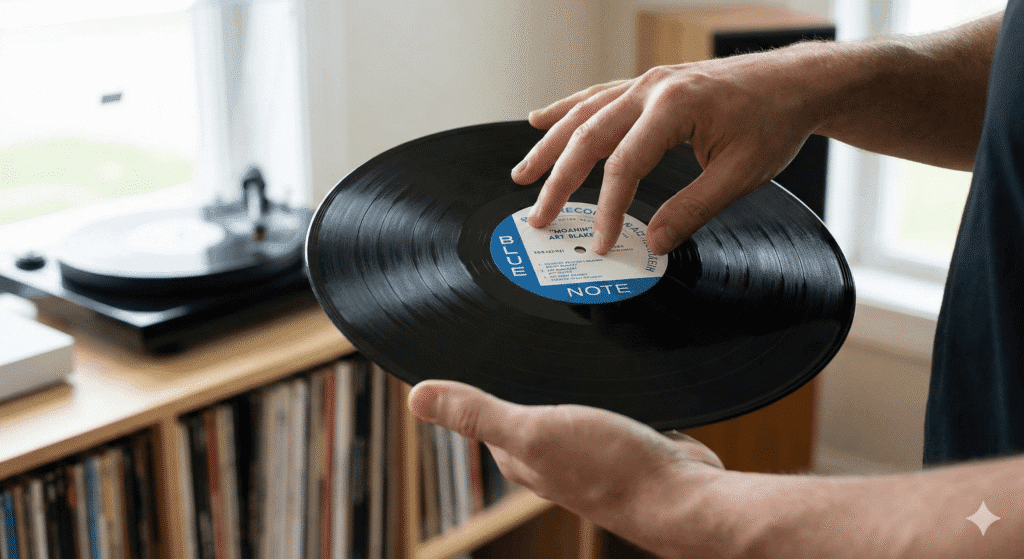
Handle vinyl records without damaging the grooves by adopting a consistent, collector-grade routine that prioritizes the disc’s physical integrity. While vinyl is a beloved medium for its warm sound, the “data” is stored in delicate PVC tracks that are highly susceptible to environmental and human interference. By following a few non-negotiable rules, you can ensure your collection remains pristine for decades.
The most critical rule of vinyl preservation is to avoid direct skin contact with the playing surface. Your fingers carry natural oils, salts, and acids that transfer to the vinyl instantly. Once embedded, these contaminants attract dust, increase surface noise (pops and crackles), and accelerate stylus wear. While professional cleaning can remove loose debris, it cannot undo the permanent sound degradation caused by repeated skin contact and abrasion.
To move a record safely, archivists utilize the “two-point hold.” This technique ensures you only touch the non-playing areas of the disc:
To handle vinyl records without damaging the grooves, you must never slide your fingers across the surface, pinch the playing area, or support the record flat in your palm. These habits create pressure points and smears that lead to long-term distortion.
Many records are damaged before they reach the turntable. A controlled removal technique is necessary to prevent “hairline” scuffs and micro-scratches.
If a record does not slide easily, static buildup or a tight paper sleeve may be the cause. In these instances, gently “buckle” the sleeve to create an air gap. Replacing standard paper with high-quality anti-static inner sleeves is a proven way to reduce future friction.
A record should only ever exist in three places: its sleeve, your hands, or the turntable platter. Placing a record on furniture, laps, or carpet—even if they look clean—can embed microscopic grit into the vinyl.
The environment is an invisible factor in groove preservation. Vinyl is a thermoplastic that softens at relatively low temperatures; warping can occur in direct sunlight or near heaters before the record even feels warm to the touch.
Static electricity, common in dry air, actively pulls dust into the grooves. You can reduce static transfer by using anti-static sleeves and briefly grounding yourself before handling your collection. Furthermore, always ensure your hands are clean and dry—free of lotions or sanitizers—before you begin. While clean hands are a prerequisite, they do not make groove contact safe; the edge-and-label rule must still be followed.
Groove damage is cumulative and irreversible. Small mistakes, like a single fingerprint or sliding a disc across a table, add up to audible noise and lost detail. However, a well-handled record from the 1960s can still play with remarkable clarity today. By remaining consistent and focusing on deliberate movements, you ensure your records provide high-fidelity sound for a lifetime.