Asking yourself, “Is my vinyl record valuable?” can lead to hours of confusing research if you do not have a system in place. This guide provides a practical, 60-second triage process to help you quickly judge whether a record is worth serious money before you dive into detailed price research on marketplaces like Discogs.
This checklist is not a pricing tool itself, but a filter to separate typical “thrift store” finds from potential treasures.
The single most significant factor in determining value is condition. A rare record in poor shape is often worth significantly less than a common record in excellent condition.
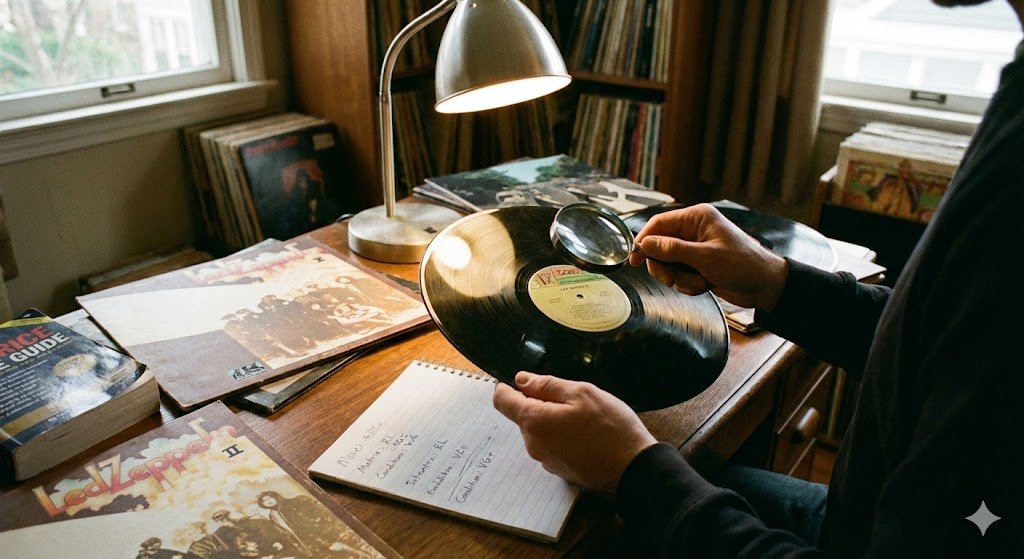
The 60-Second Light Test: To assess this quickly, hold the vinyl under a direct light source.
The Jacket Check: Inspect the outer sleeve. Split spines and water damage are major red flags. If a record jacket smells of mold, the value usually drops to zero, even if the vinyl looks clean. This quick visual assessment maps closely to the Goldmine or Discogs grading scale, where “Near Mint” or “Very Good Plus” commands high prices, while “Good” or “Poor” condition slashes potential value.
Once a record passes the condition check, look for specific manufacturing details. Early pressings, small labels, and limited editions are often more valuable than mass-market reissues.
Green Flags (Potential Value):
Red Flags (Likely Low Value):
For the final step in your physical inspection, look at the “dead wax”—the smooth runoff area near the center label. This area often contains handwritten or stamped codes that identify the specific mastering engineer or pressing plant.
The “Money” Marks: Tiny initials in the runout groove can turn a $20 record into a $200 record.
If you find these specific codes, the record warrants a detailed search. (See our full guide on reading Dead Wax for more details.
Supply and demand ultimately dictate price. Just because a record is old does not mean it is valuable.
The “Heavy Hitter” Test:
Scarcity plays a major role here. Cult followings, banned covers, or albums never reissued on other formats are classic indicators of high value. Conversely, endless reissues suggest lower used values.
The goal of this checklist is to decide whether a record is “worth a quick Discogs search” or “probably yard-sale value.”
Once a record passes your 60-second screen, use Discogs to identify the exact pressing via the catalog number. However, be careful not to rely solely on asking prices. Always check the sold history to see what buyers are actually paying.
By using this checklist, you can stop guessing and start accurately triaging your collection, saving the deep-dive research for the records that truly deserve it.