Welcome to the Original Vinyl Pressing: Complete Guide to Spotting Early Presses. Picture this: You’re flipping through the bins at Recycled Records, and you stop. You’re holding a copy of a classic album—maybe it’s Led Zeppelin or a Blue Note jazz record. It looks old. It smells old. But is it a first pressing vinyl copy?
For collectors, the first pressing is the holy grail. These records come from the earliest production run when an album was first released. They carry value because of their rarity, historical importance, and often, their superior sound. But identifying one isn’t as simple as checking the date on the back cover—the most common mistake newcomers make.
Whether you’re new to collecting or sharpening your crate-digging skills, this guide breaks down the hidden language of vinyl and shows you how to identify an actual first pressing.
Do not rely solely on the printed date. A record pressed in 1980 can still show “©1969” because that date refers to artwork copyright, not the pressing year. Covers are reprinted for decades without updating this detail.
To uncover the truth, you need to examine the record itself.
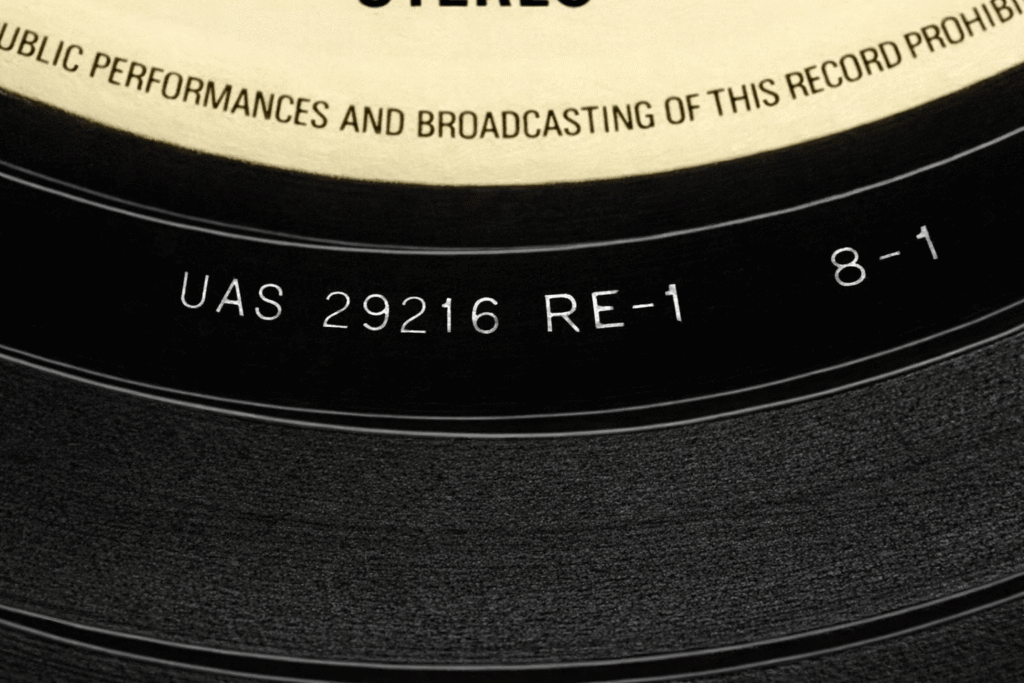
The deadwax—also known as the Matrix/Runout—is the smooth area between the last groove and the label. Hold it to the light, and you’ll see etched or stamped alphanumeric codes that reveal pressing details.
What to Look For
Matrix Suffix: Codes like A1/B1 or -1A/-1B typically indicate the earliest cut. Higher numbers (-2, -3, -4) usually signal later recuts.
Mastering Signatures: These initials identify who mastered the record.
RL – Robert Ludwig (Led Zeppelin II “hot mix”)
RVG – Rudy Van Gelder (Blue Note, Prestige jazz)
Porky – George Peckham (UK rock classics)
Low matrix numbers and early mastering marks are among the strongest indicators of a first pressing vinyl copy.
Label variations are “Vinyl 101.” They change over time—and those changes help pinpoint the era.
Key Clues
Logos: Columbia “6-Eye” labels signal early pressings; later versions may feature “2-Eye” or plain text.
Addresses: Early labels list detailed locations (“47 West 63rd NYC”). Later reissues offer broader identifiers (“New York USA”).
Deep Groove: Many pre-1965 records have a circular indentation beneath the label—known as a deep groove—often aligning with early pressings.
Jackets can reveal the pressing era before you even remove the record.
Telltale Signs
Barcodes: Introduced in the early 1980s. If a ’60s or ’70s album has a barcode, it’s a reissue.
Construction: UK/European albums once used “flip-back” sleeves—front panels folded over the back. These disappeared by the late ’60s.
Modifications: Early covers often include text or catalog details that are later removed (e.g., early “Stereo” banners on Beatles albums).
Never guess—confirm. Databases like Discogs let you match your copy to the correct pressing.
How to Verify
Enter the catalog number from the spine or label.
Filter by country.
Most important: Compare your Matrix/Runout codes with the listing.
If the deadwax codes don’t match the entry, you likely have a different pressing variation—not the first.
| Feature | First Pressing | Reissue / Repress |
| Timing | Made near the original release date | Made years later |
| Deadwax | Low numbers (A1, -1) | Higher numbers or new codes |
| Cover | No barcode (pre-1980s) | Often includes a barcode |
| Sound | Original mastering | May be remastered |
| Value | Higher, collectible | Typically more affordable |
Identifying early vinyl pressings is part art, part science, and part detective work. While first pressings are prized for uniqueness and sound, clean reissues remain an excellent way to enjoy the music without the premium price.
Whether you’re hunting for the elusive RL cut of Led Zeppelin II or simply want a clean copy of a favorite album, stop by Recycled Records LP in Longmont. We’re always happy to help you inspect the dead wax and decode the clues.
Visit us today or explore our collection online.