
Blog
Identify First Pressings: Vinyl Collector’s Guide


You pull a dusty copy of Led Zeppelin II from a crate at an estate sale. The cover looks promising, but experienced collectors know the jacket rarely tells the whole story.
The real clues are hidden in places most people never inspect. A small string of letters etched into the dead wax. A subtle variation in the label. A pressing plant code is buried in the runout groove.
Those details can be the difference between a common reissue and a highly sought-after first pressing.
Learning how to identify vinyl record labels and pressings is one of the most valuable skills a collector can develop. Whether you’re buying records, inheriting a collection, or trying to determine the value of a record you already own, understanding how to read these clues can help you identify exactly what you’re holding.
Every Record Tells a Story
Most collectors begin with the album cover, but the investigation quickly moves beyond the jacket.
The first thing to examine is the record label itself. Record companies regularly changed logos, fonts, manufacturing information, and company addresses throughout the years. Those changes create a timeline that can help narrow down when a record was produced.
A collector examining a Beatles album may notice that one label design was only used during a specific release period. Another pressing may use a later logo variation that immediately identifies it as a reissue.
The catalog number is equally important. You’ll typically find it on the label, spine, jacket, and sometimes the inner sleeve. Think of the catalog number as the record’s identification number. It won’t always tell you exactly which pressing you have, but it provides the starting point for further research.
Many collectors make the mistake of relying entirely on the cover. Covers get replaced, mixed, and damaged over time. The vinyl itself is usually a much more reliable source of information.
The Dead Wax Is Where Collectors Find the Truth
If there is one area every collector should learn to inspect, it’s the dead wax.
The dead wax is the smooth section between the final music groove and the center label. At first glance it looks empty, but this small space often contains the most important information on the entire record.
Hold the record under a bright light and slowly rotate it. You’ll usually discover a combination of stamped characters, handwritten notes, matrix numbers, and manufacturing marks.
Visual Reference:
Music Groove
↓
Dead Wax / Runout Area
↓
Center Label
This runout area is where the record begins telling its real story.
Many collectors refer to the process as learning how to “read the dead wax.” Once you develop this skill, identifying records becomes much easier.
Understanding Matrix Numbers
Matrix numbers are production codes used during manufacturing. They help identify the exact version of a release and often reveal much more than the label alone.
Two copies of the same album may share identical artwork, catalog numbers, and labels, yet have completely different matrix numbers.
Those differences matter.
Collectors often look for low-number suffixes such as A1, B1, -1, or -1A because they can indicate an earlier cut from the master lacquer. While every record company used different systems, lower matrix numbers frequently point to earlier pressings.
When researching a specific pressing, matrix information often becomes the deciding factor.
The Importance of Mastering Engineer Signatures
Some records contain initials or signatures from the mastering engineer who cut the lacquer.
To casual listeners, these markings may seem insignificant. To collectors, they can be incredibly important.
One of the most famous examples is Robert Ludwig’s “RL” cut of Led Zeppelin II. Copies containing the RL signature have become legendary among collectors because of their exceptional sound quality.
Other recognizable markings include:
-
- Sterling
-
- Masterdisk
-
- Porky
-
- RL
Finding one of these signatures can instantly make a record more desirable.
Pressing Plants Matter More Than Most People Realize
Not all records were manufactured in the same place.
A pressing plant is the facility where records are physically produced. Different plants often left unique identifiers in the dead wax, making it possible to determine where a record originated.
Common examples include:
-
- Terre Haute
-
- Pitman
-
- Santa Maria
-
- Monarch
-
- Specialty Records
Some collectors actively seek records from particular plants because they believe they offer better pressing quality or superior sound.
In certain cases, a pressing from one plant may command a premium over an otherwise identical copy manufactured elsewhere.
How Collectors Identify First Pressings
The phrase “first pressing” gets used constantly in the vinyl world, but identifying one requires more than looking at a release date.
A true first pressing generally comes from the earliest commercial production run of a record.
Collectors typically look for a combination of:
-
- Early label variations
-
- Original catalog numbers
-
- Low matrix numbers
-
- Original manufacturing credits
-
- First-release packaging
The key is using multiple clues together rather than relying on a single detail.
A Beatles album may have the correct label but the wrong matrix number. A jazz release may have the correct matrix number but a later jacket.
The more evidence you gather, the more confident your identification becomes.
First Pressing vs Reissue
One of the most common mistakes collectors make is assuming every older record is a first pressing.
In reality, many records were reissued multiple times over several decades.
A reissue is simply a later production of the same album. Some reissues are excellent. Others are highly collectible in their own right.
Common signs of a later pressing include:
-
- Barcodes on older albums
-
- Updated logos
-
- Different label layouts
-
- Revised copyright information
-
- Modern manufacturing details
A reissue isn’t automatically less valuable. Some audiophile reissues have become extremely desirable among collectors.
The goal is simply knowing which version you own.
Using Discogs Without Getting Lost

Discogs has become the most powerful tool available for record identification.
The mistake many beginners make is searching only by artist and album title.
Instead, start with:
Catalog Number + Matrix Number
This immediately narrows the search.
When comparing Discogs listings:
-
- Match the label photos
-
- Compare matrix numbers
-
- Review release notes
-
- Verify country of origin
-
- Check the pressing plant information
Pay attention to every character in the runout groove.
One small difference in a matrix code can point to an entirely different release.
Patience is often rewarded.
Why Some Pressings Are Worth More Than Others
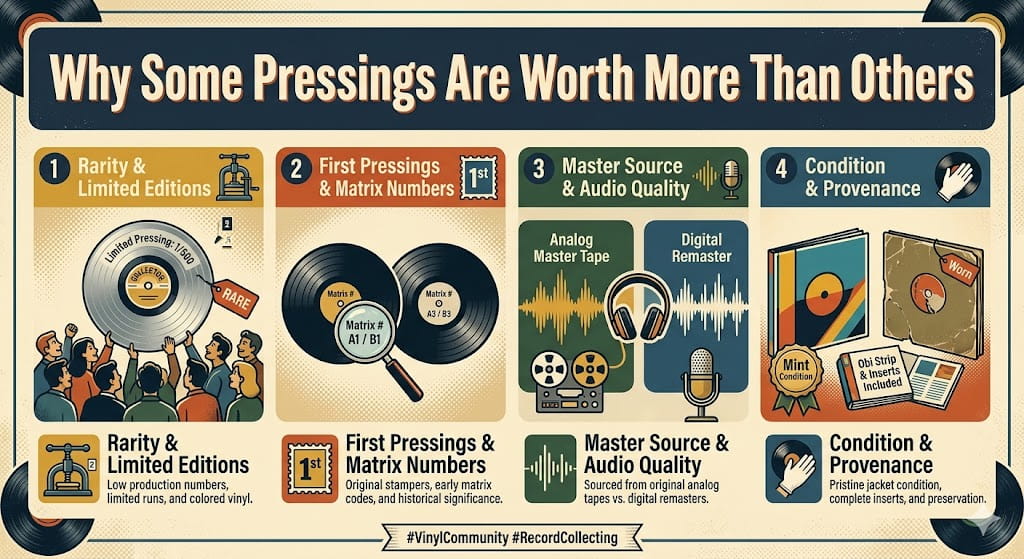
Collectors are often surprised to learn that age alone does not determine value.
Several factors influence pricing.
Rarity
Records produced in smaller quantities tend to be more desirable.
Demand
Popular artists naturally attract more collectors.
Condition
A mint condition copy generally commands a higher price than a heavily played example.
Sound Quality
Certain cuts simply sound better than others. This is why mastering engineer signatures and original master cuts attract attention.
Historical Significance
Original pressings often hold special appeal because they represent the earliest version released to the public.
The combination of these factors determines market value.
Real-World Examples
Blue Note jazz records provide one of the best examples of why pressing identification matters.
Two copies of the same title may look nearly identical. One may be a valuable original pressing worth hundreds or even thousands of dollars. The other may be a later reissue worth a fraction of that amount.
The same principle applies to Beatles records, Led Zeppelin releases, early punk albums, and countless other collectible records.
The ability to spot those differences is what separates experienced collectors from casual buyers.
The Five-Minute Record Check
Whenever you encounter a record, follow this process:
-
- Examine the label.
-
- Record the catalog number.
-
- Inspect the dead wax.
-
- Note the matrix numbers.
-
- Look for engineer signatures.
-
- Identify pressing plant markings.
-
- Search Discogs.
-
- Compare release information.
-
- Confirm whether it is a first pressing, reissue, or later pressing.
This simple workflow can save you from costly mistakes and help uncover valuable records hiding in plain sight.
Final Thoughts
Every vinyl record has a story. The challenge is learning how to read it.
The label, catalog number, dead wax, matrix codes, and pressing plant information all work together to reveal the history of a release. Once you understand how these pieces fit together, you’ll be able to identify records with far greater confidence.
The next time you’re crate digging, don’t stop at the cover. Turn the record over, inspect the runout groove, and let the vinyl tell its story.