
Blog
Stylus Tracking Force: Its Impact on Sound and Record Wear

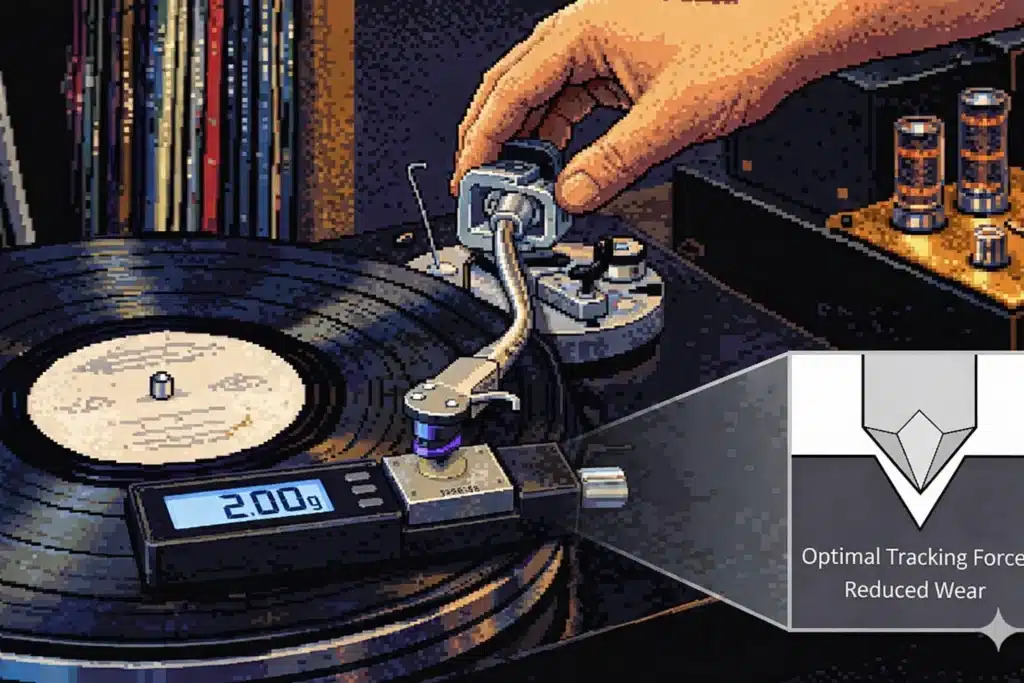
Stylus tracking force has more influence on sound quality and record life than almost any other part of your turntable setup. When this downward pressure is correctly calibrated, it protects your vinyl; however, when it is wrong—either too high or too low—it can permanently damage grooves surprisingly quickly.
1. What Is Stylus Tracking Force?
Stylus tracking force is the downward pressure the cartridge exerts on the record, measured in grams. In most hi-fi systems, this sits roughly between 1.5g and 2.5g and is adjusted using the tonearm counterweight. The cartridge manufacturer always specifies a usable range and often a recommended value within that range. This force keeps the stylus seated in the groove so it can follow the tiny modulations that encode the music rather than bouncing or scraping.
2. Why Groove Physics Make Pressure Critical
A vinyl groove is a microscopic V-shaped trench, narrower than a human hair, with your stylus touching the groove walls at just two tiny contact patches. If the pressure is too low, the stylus cannot stay fully engaged and will tend to ride up, chatter, or skip. If the pressure is too high, the stylus can compress and deform the soft PVC, “plowing” the groove rather than gliding through it. Both extremes cause wear, but the accumulation of that damage differs.
3. The Hidden Dangers of Low Stylus Tracking Force
Running too little weight is a very common mistake, especially among collectors who assume “lighter must be safer.” In reality, under-tracking is often more destructive than over-tracking.
Consequences of Under-Tracking
- Stylus Mistracking: The stylus intermittently loses contact with the groove walls.
- Micro-Chipping: The stylus behaves like a tiny hammer, delivering concentrated impacts when it slams back into the groove.
- Frequency Loss: Audible sibilance, splashy cymbals, and high-frequency distortion occur, particularly during loud or complex passages.
Because these high-pressure impact points can exceed what the vinyl can elastically recover from, under-tracking often damages grooves faster than running at the upper end of the recommended range.
4. Understanding Over-Tracking and Vinyl Record Wear
Excessive pressure produces a different pattern of damage known as “The Plow Effect.”
Consequences of Over-Tracking
- Groove Wall Compression: The vinyl is pushed beyond its elastic limit.
- Detail Loss: Permanent deformation gradually rounds off fine details and transient definition.
- Increased Friction: Surface noise accumulates as micro-scuffs develop, and the diamond stylus wears down faster.
Modern hi-fi cartridges are engineered so that staying within the manufacturer’s window is safe. Problems usually arise only when you exceed that range or use high-force DJ cartridges on delicate records.
5. Finding the “Safe Zone” for Record Longevity
The safest long-term strategy is to track near the upper-middle of the manufacturer’s range. For example, if the recommended range is 1.8g – 2.2g, a setting of 2.0g is sensible. This keeps the stylus stably seated, minimizes “bouncing” events that gouge the groove, and preserves both the stylus and record over hundreds of plays.
6. How Stylus Shape and Cartridge Alignment Change the Equation
The stylus profile determines how the tracking force is distributed across the groove.
- Conical (Spherical): Small, rounded contact area. It requires higher force and concentrates wear in a narrow band.
- Elliptical: Contacts more of the groove vertically, improving high-frequency tracking.
- MicroLine / Shibata: These advanced “line-contact” shapes use an elongated contact patch. This spreads the weight over a larger area, significantly lowering pressure per square micron and reducing wear potential when cartridge alignment is precise.
7. Balancing Anti-Skate Settings
Tracking force works in tandem with anti-skate, which counteracts the inward pull of the tonearm. If anti-skate is mis-set, one groove wall carries most of the load, leading to uneven wear and channel imbalance. A common rule is to set anti-skate to roughly match the tracking force (e.g., 2g tracking force = 2 on the anti-skate dial).
8. Essential Record-Safe Playback Checklist
To ensure your collection sounds fresh after years of use, follow this protocol:
- Set tracking force near the manufacturer’s recommended “sweet spot.”
- Use a digital scale for accuracy rather than relying on tonearm markings.
- Ensure accurate cartridge alignment (overhang, zenith, and azimuth).
- Maintain a clean stylus and clean records to minimize abrasive contamination.
- Set anti-skate settings to match the tracking force.
9. The Bottom Line for Collectors
Properly set stylus tracking force is one of the smartest investments you can make in your vinyl system. While too light a force leads to violent mistracking and chipping, and too heavy a force causes cumulative deformation, the “Goldilocks” zone ensures stable, low-wear playback. Treating this as a precise, non-optional part of your setup protects the long-term value and sound quality of your collection.