In the landscape of 1990s alternative music, few acts shaped a genre as profoundly as Portishead. Their 1994 debut, Dummy, didn’t just popularize trip-hop—it defined it. But when the time came for a follow-up, the Portishead self-titled album, released in 1997, the band faced a challenge: how do you evolve when your own sound has become everyone’s blueprint?
Their answer was simple yet revolutionary: look inward—and sample themselves.
Following the massive success of Dummy, guitarist Adrian Utley reflected that they “heard our own sound all around us… and had to reinvent ourselves.” This pressure, combined with a year of creative paralysis, pushed Beth Gibbons, Geoff Barrow, and Utley to retreat to a rural English studio.
Their goal was to strip away expectation and rediscover authenticity. What emerged was darker, more personal, and startlingly raw.
The most innovative element of the Portishead self-titled album wasn’t just its eerie melodies or Gibbons’ arresting vocals—it was the decision to abandon traditional sampling altogether.
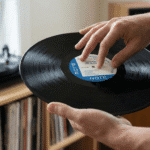
While Dummy was built on obscure vinyl loops, Portishead was built from scratch. The band meticulously recorded original instrumental fragments—live drums, guitars, Rhodes piano, Mellotron, and modular synths—then pressed those recordings onto vinyl acetates.
They didn’t stop there.
This analog experimentation gave them the vintage warmth of dusty samples—but entirely under their own control. The pops, crackles, and flaws became integral to the mood, celebrating the beauty of imperfection and the tactile soul of sound.
Recorded primarily at State of Art Studios in Bristol with engineer Dave McDonald, the sessions leaned heavily on vintage analog equipment, tape saturation, and minimal digital editing.
The result was a thick, uneasy atmosphere where live jazz trumpets and strings intertwined with hip-hop beats and brooding basslines. Tracks like “Cowboys”, “All Mine”, and “Half Day Closing” throbbed with a tension that felt both human and mechanical.
Lyrically, Beth Gibbons delivered her most emotionally exposed performances yet—less wistful, more confrontational. Her voice cut through the dense production with palpable vulnerability, reflecting both personal struggle and the band’s exhaustion with media attention.
Released in September 1997, the Portishead self-titled album debuted at No. 2 on the UK Albums Chart, reaffirming the group’s status as pioneers of sound design. By sampling themselves, Portishead transformed the act of creation into self-exploration—turning analog decay into emotional resonance.
More than two decades later, the album’s influence still reverberates through modern electronic and alternative music. It remains a blueprint for creative reinvention—proof that sometimes, the best way forward is to go deeper inward.