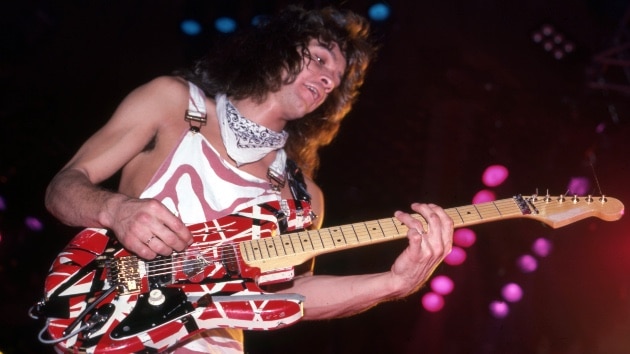
The Frankenstein Guitar — more famously known as the Frankenstrat — is one of the most recognized instruments in rock history. Built by Eddie Van Halen himself, this electric guitar blended the physical attributes and tremolo bar functionality of a Fender Stratocaster with the tone of a Gibson P.A.F. humbucking pickup. Its striped red, black, and white paint job, along with its hand-built modifications, made it not just a signature guitar but a revolutionary piece of guitar engineering.
Whether you’re a guitar tech, a collector, or simply a fan of Van Halen, this is the complete guide to the original Frankenstrat, its guitar features, and why it remains one of the most influential rock guitars ever built.
The Frankenstein guitar is the original guitar Eddie built in 1977 by combining parts from different manufacturers. He used a Fender Stratocaster-style guitar body from Charvel, installed a Gibson P.A.F. humbucking pickup, and added a Floyd Rose tremolo for greater pitch-shifting control.
Eddie’s goal was to create a guitar with the physical attributes of a Strat but the sound of a classic Gibson, something no commercial model offered at the time.
This custom build became known as the original Frankenstrat, a striped guitar that would be immortalized on album covers like Van Halen II and 5150.
To create the guitar built for his needs, Eddie purchased a factory-second Fender-style body for $50 and a maple neck for $80.
He replaced the original bridge with a Floyd Rose locking system to keep tuning stable during aggressive whammy bar use.
The routing on the body allowed space for the humbucking pickup, which he mounted at an angle for a unique tonal response.
Eddie even dipped the pickup in paraffin wax to reduce feedback — a trick many guitar techs now use regularly.
The paint job of the Frankenstrat is as legendary as its sound. Eddie began with an original black base, then added white stripes using a strip of double-sided masking tape for clean lines. Later, he sprayed over with red lacquer, creating the now-famous striped series look.
Over time, the finish wore naturally, adding to its raw, road-worn aesthetic. This striped guitar became a visual signature almost as famous as Eddie’s riffs.
The guitar had the features no mass-produced model offered in the late 1970s:
Together, these design choices gave the Frankenstrat unmatched playability for Eddie’s fast, tapping-driven guitar playing.
The original Frankenstrat isn’t just a piece of gear — it’s a piece of rock history. One version resides in the Smithsonian Institution, while another was displayed at the Metropolitan Museum of Art in its “Play It Loud” exhibition.
The guitar’s influence also lives on in the Fender Custom Shop replica guitar models, which aim to recreate every scratch, chip, and reflector sticker — just like the original.
After years with the Frankenstrat, Eddie worked with Kramer, Ernie Ball Music Man, Peavey, and finally EVH Gear to produce the EVH Wolfgang series.
These signature guitars carry the DNA of the Frankenstrat but feature modern upgrades like the EVH Wolfgang humbucker, refined neck profile, and improved volume control taper.
The Wolfgang models, including limited custom shop runs, continue to inspire guitar heroes and players chasing Eddie’s tone.
The demand for a Frankenstein replica has never faded. Players seek replica guitar models to experience the sound of a classic and the attributes and tremolo bar functionality that Eddie pioneered.
High-end builds from the Fender Custom Shop and third-party luthiers use period-correct parts, Gibson and Fender hardware, and, like the original, relic finishes.
Even limited runs of the white Frankenstrat have become valuable gear among collectors.
Eddie’s Frankenstrat reshaped what a rock guitar could be. It inspired the “Superstrat” boom of the 1980s, leading brands like Charvel, Kramer, and Schecter Guitar Research to produce hot-rodded Strats with humbucking pickups, tremolo bars, and faster fretboards.
The concept of merging Gibson and Fender design philosophies became a template for modern high-performance guitars.

From Hot for Teacher to For Unlawful Carnal Knowledge, Van Halen used the Frankenstrat to define an era.
Alongside David Lee Roth, Eddie’s riffs and solos set new standards in rock and roll.
Even as technology evolved, Eddie’s early volume knob swells, dive bombs, and harmonic squeals from the Frankenstrat remain unmatched.
Interestingly, the “Frankenstein” name has been embraced outside the Van Halen world — including by Doyle Wolfgang von Frankenstein of the Misfits, whose stage guitars carry their monstrous aesthetic.
The spirit of customization, however, always ties back to Eddie’s original vision.
Preserved in museums, celebrated in Guitar World, and reproduced in custom shop models.